
The Difference Between Belief and Knowledge
The return to fundamentals

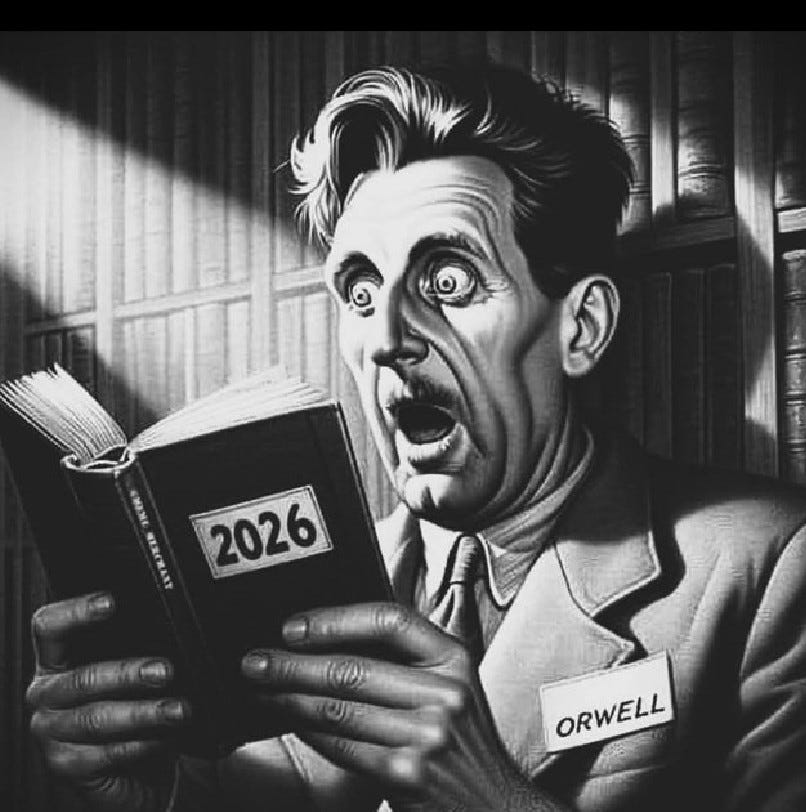
It has been a consequence of the past few decades, where we have been gaslighted to the edge of insanity - and accelerated exponentially over the past few years - that the notion of a “post-truth” world has emerged. The definition of post-truth, according to the Cambridge dictionary is:
post-truth
adjective
relating to a situation in which people are more likely to accept an argument based on their emotions and beliefs, rather than one based on facts:The referendum was the first major vote in the era of post-truth politics.
He dubs the current administration a “ post-truth” White House.
Living in a world where people do not give a sh*t about facts is every authoritarian, dictatorial, totalitarian and fascist’s wet dream. Spin them a good enough story and they’ll believe if they want to. F*ck the facts.
It doesn’t matter if Tommy Robinson is shilling for Israel and saying he’d fight for a foreign state; he’s a ‘patriot’!
It doesn’t matter if Trump has given up much of US’s sovereignty to the influence of a foreign state; he’s a ‘patriot’!
It doesn’t matter that Keir Starmer held membership of the Trilateral Commission, is selling the country to BlackRock, using British citizens to help commit a genocide and declaring his ‘without qualification’ allegiance to Zionism; he’s ‘better than Farage!’
As I’ve said before, it used to be that seeing was believing. But now, believing IS seeing. What we believe is what we see; and from that frame of mind there is not a single fact, evidence or proof that can change a mind.
And that’s where we are now. Bullsh*t reigns supreme while the people of thought, understanding, logic and rationality are living in a Kafkaesque, Orwellian hellscape, with Trump only promising to making its reach even larger once he brings democracy, peace and freedom to the whole wide world. Yay for us!
It did occur to me that perhaps due to the non-stop bullsh*ttery of these times, that perhaps we have simply forgotten how to think: that even the basic fundamentals between subjective belief and objective knowledge are so merged that people cannot tell the difference.
I came across the following which I wrote a long time ago to explain some metaphysical philosophical concept to someone in the simplest way I could. I won’t paste the whole piece, but just the section discussing the difference between belief and knowledge. Because we all need to take a breath sometimes - and sometimes reading these things aloud help us ground ourselves again.
Enjoy!
Part 1: The Difference between Belief, Knowledge and Certainty
As all philosophers know, belief and knowledge are two distinct entities. However, as metaphysical knowledge thus far eluded us, the idea of ‘hard’ and ‘soft’ knowledge has emerged. For the purposes of this essay, these two terms must be eradicated and the original meaning of knowledge will be used, that is something either is known or it is not known: it cannot be qualified. If something is not known, any thought upon it is, by definition, a belief.
To reinforce the distinction, let us look at some examples.
Belief
Belief is subjective. It is purely based on the person who holds the belief.
Belief is no more than an opinion based on interpretation of evidence presented to the individual.
As such, beliefs can also change at any time, dependant on the holder.
An example:
Mark is at work. Suddenly, there is short earthquake. It stops and Mark continues his work.
That evening, Mark returns home. He enters the lounge and it is a mess. There are books from the bookshelves all over the floor. In the corner of the room, his dog has a book in its mouth.
Based on the evidence presented, Mark can hold one of many different beliefs. However, they will probably be one of three, namely, he concludes that:
1). The earthquake caused the mess, or;
2). The dog caused the mess, or;
3). Both the earthquake and the dog caused the mess.
None of these beliefs can be proven as he was not there to witness the event. Thus he uses his reasoning, examines the evidence presented to him (the mess; the earthquake; the book in the dog’s mouth) and comes up with a conclusion he believes is most plausible. This may not be the same conclusion you or I believe most likely to have happened.
Of course, while we’ve outlined three possibilities, the potential scenarios are limitless. Mark could have held a myriad of beliefs about the unfolding event, reflecting the expansive range of possibilities that might have occurred.
For instance, Mark could believe that neither the earthquake nor the dog caused the mess. He may believe it was the cause of a burglar or a jilted ex-girlfriend who had not yet returned his key. He may even believe he had been visited by aliens!
To emphasise, there are an unlimited number of possibilities which could have happened and thus an unlimited number of beliefs of what occurred to choose from.
However, there is one only set of events that actually happened to cause the mess. In other words, there are an unlimited number of possibilities which are false but, there is only one true set.
Truth, by its very definition, can only be one. As such, a body of truth - that is, a number of statements relating to truth - can only be one. Just as if a single drop of poison will contaminate a glass of water, one false statement within the body of statements immediately negates the body of truth and it becomes automatically false.
An example.
Let’s look at my daily routine and create a body of statements:
1). I wake up
2). I brush my teeth with an electric toothbrush
3). I eat breakfast
4). I get changed
Now, let’s look at the next body of statements:
1). I wake up
2). I brush my teeth with a manual toothbrush
3). I eat breakfast
4) I get changed
The majority of the above statements are true. However, statement 2) is false. Thus, the whole body taken as one, is false.
Any of the above can be changed to make the body of statements false. They can be changed in an unlimited number of ways. As such, falsehood is unlimited. There can only be one truth however, and only one true body of statements.
Let’s return to Mark. The truth of the matter is, it was not the earthquake but it was the dog who caused the mess in the room. Truth is one - that is to say, it is the only thing that happened.
Now, Mark may have concluded himself the belief that it was indeed the dog who caused the mess. However, he did not know this.
He could not have known this as he was not there. He simply has a belief of what occured and his belief coincides with reality. Thus, a coincidentally true belief is just the same as any other belief: it lacks knowledge and is simply a belief.
This is the same reasoning behind jury directions in criminal courts and the requirement of ‘beyond reasonable doubt’. Even if strong forensic, photographic and even video evidence is provided, jurors will only ever hold belief of the events that occurred and can never know. There is always a possibility that they are wrong. As such, the judge directs:
“Ladies and gentlemen of the jury, it is your duty to carefully weigh the evidence presented. The prosecution must prove the defendant’s guilt beyond a reasonable doubt. This does not mean absolute certainty, but it requires you to be firmly convinced and to have a moral certainty that the defendant is guilty based on the evidence presented. If, after careful consideration, you have no reasonable doubt about the defendant’s guilt, you should find them guilty. However, if there is any reasonable doubt, it is your duty to acquit. The burden of proof rests entirely on the prosecution, and the defendant is presumed innocent unless proven guilty beyond a reasonable doubt.”
In other words, belief is always possibly true and possibly false.
Knowledge
In its simplest form, proof is conclusive. It is a known fact. It is not evidence-based. As such, it is not a body of information from which multiple conclusions can be derived. It is conclusive.
As proof is conclusive it is something which can be known. What is known, cannot be unknown.
Knowledge is objective. It is known to each individual equally. It does not require subjective analysis, subjective opinions nor evidence to suggest its truth. One can either know something or not know something. There is no in-between.
Evidence is a body of information which suggests something or another. Science is based on evidence alone. Scientists may claim the evidence to be ‘strong’, that is to say they have found a lot of information pointing to the same conclusion. However, as we have seen, just because something is possibly, or even probably true, does not make it true. If it turns out to be true it is simply coincidental.
Something possibly true is also possibly false.
Knowledge can be a priori or empirical. We know the existence of clouds because we can see them. In other words, it is empirical knowledge.
A priori knowledge, by contrast, does not depend on experience. It is knowledge gained through logic alone, such as mathematical or logical truths. An example is that a triangle must have three sides. These truth is known without observing anything in the physical world.
Certainty
Certainty is of two types:
1) Psychological (emotional) certainty. This certainty is entirely subjective. For example, when a person says, ‘I just know Elvis is alive!’ It is subjective to the holder and requires no proof. It is merely a belief.
2) Intellectual certainty. This is knowledge. It is known because it is proven. It does not require evidence. One can either have intellectual certainty about a matter or not. In other words, they can either know something or not know something.
….
Deduction
As we know, a deduction consists of two premises: a major premise (P1) and a minor premise (P2) of the same subject matter.
This then leads to a conclusion (C).
An example:
P1: All men are mortal
P2: Socrates is a man
C: Socrates is mortal
In other words, a deduction takes a big sample of a subject matter (in this case, all men), then it takes a smaller sample of that same subject matter (Socrates, a man) and then makes a conclusion about that small sample, based on the big sample.
A deduction is invalid if premises are not concerning the same-subject matter.
An example of an invalid deduction:
P1: All ducks are mortal
P2: Thomas is a man
C: Thomas is mortal
However, just because a deduction is valid, that is it meets the rule of validity above, does not mean the conclusion is true or correct.
This is because the truth of the premises must be established before the conclusion can be said to be true.
An example:
P1: Every time Luke sleeps at night, he wakes the next morning
P2: Luke is sleeping tonight
C: Luke will wake in the morning
The deduction above is valid - that is, the subject matters in the premises match. However, the conclusion cannot be said to be true.
This is because the premises need to be established as true for the conclusion to be true. It is true that Luke has until now, woken after every sleep. However, it cannot be known if that will continue and that the statement is true for all future sleeps. That is, just because he has woken every day up till now, does not mean Luke will wake tomorrow.
….
Induction
Induction consists of one premise, from which a conclusion is then made. The premise represents a small sample, and then the conclusion is extrapolated to contain all such instances.
An example:
P: All swans that anyone has ever seen are white
C: All swans are white.
It may be that all swans that have thus far been observed are white. However, one instance of a black swan will negate the induction totally.
Thus, induction is not a method that can thus be used in the pursuit of knowledge.
It simply produces a belief which is invalidated by a single instance of difference.
Wait till Part 2 😉